
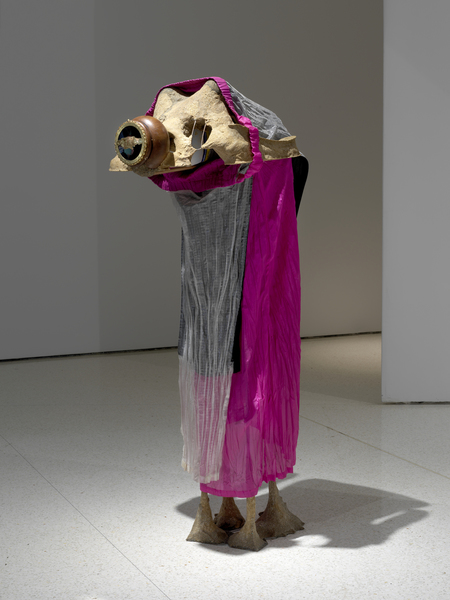
Mannequin (with dress) No. 1, Sandra Lee, 2005
Akeem Smith in collaboration with Jessi Reaves

Akeem Smith and Jessi Reaves
Mannequin (with dress) No. 1, Sandra Lee, 2005, 2020
Metal, sawdust, wood glue, wood, hardware, original garments, custom jewelery
142 x 50.8 x 85.5 cm
TBA21 Thyssen-Bornemisza Art Contemporary
Photo: Dario Lasagni
- Date
- 2023
- Medium
- Metal, sawdust, wood glue, wood, hardware, original garments, custom jewelry
- Dimension
- 145 x 53 x 62 cm
- Credit
TBA21 Thyssen-Bornemisza Art Contemporary Collection
- This artwork is part of the donation and long-term loan from TBA21 to the Museo Nacional Thyssen-Bornemisza.
Details
Growing up between New York and Jamaica, Akeem Smith’s practice retrieves and recounts the chronicles of the early years of dancehall culture. Through a collection of materials from the beginning of the 1980s through the early 2000s, his research takes form through installation, video, photography, and sculpture. Aspiring to give a voice to the collective memory of the dancehall genre, he intertwines personal experiences, anecdotes, icons, and histories of Jamaica. The sculptures Mannequin (with dress) stem from a collaboration between Smith and American sculptor Jessi Reaves, whose work combines found objects in playful assemblages that question the limits of art and design, function and form, performing a satirical character in relation to iconic modernist objects.
The two sculptures pay homage to Jamaica’s dancehall queen Sandra-Lee Smith, who helped pioneer the fiercely original and glamorous early era of dancehall fashion. In an assemblage of found materials, original garments, jewelry, metal, and wood, the “mannequins” evoke a human figure, or perhaps a prop for modeling a dress. Their archaic compositions capture hilarious postures, gestures, moves, and expressions with a rough humor and lightness, while telling a history of style and empowerment, rooted in Jamaican and Afro-Caribbean cultures and aesthetics. With their tactile qualities and rhythms, the wooden effigies speak to the voyeuristic nature of dancehall culture, evoking themes of lust, physicality, and euphoria.
Smith describes his process as “archiving attitudes and swagger,” distilling the distinctive styles, poses, and the confidence displayed by the exceptional individuals who created Jamaica’s vibrant culture. The tribute to one of the icons of the dancehall community becomes an emblem for the recuperation and preservation of the entire culture. Smith identifies himself as “the archivist of the family” acting against cultural erasure, an ethnographer of dancehall, and curator or “hoarder,” accumulating, searching, and gathering a vast amount of found materials, photographic and filmic footage, oral histories, and experiences from within the dancehall community.
(Text written by TBA21 and used as a wall label for the exhibition "Remedios", C3A, Cordoba, 2023)

